


Once upon a time, I went to the White House in Washington, DC, for an award ceremony honoring historic preservation work across the nation. The program was inspirational, and the first lady was gracious, but I was most struck by the White House’s interior. The paneling glowed; the American artwork that festooned the walls was perfectly preserved, as were the antique furnishings. It felt welcoming, and I was proud to be an American. So, I, along with many others, was horrified by the sudden demolition of the east wing of the complex. And as it turns out, it was not only our country’s citizens who were appalled. In a recent message board devoted to cultural landscapes, Pierre Marie Tricaud, an expert on World Heritage from France, queried:
Dear friends,
As I was shocked to discover that President Trump had ordered the destruction of part of the White House, my first hope was that UNESCO would react, “given that it is a World Heritage Site.” I admit that I had always naively believed that the urban ensemble of Washington, D.C., was inscribed on the World
Heritage list. However, neither the ensemble nor any of its buildings are listed, not even on the tentative list. Why is it that L’Enfant’s magnificent urban project—the Versailles of democracy—with its iconic
buildings and built and outdoor spaces that have witnessed so many major historical events, not only in the history of the United States but also in world history, is not recognized as having Outstanding Universal Value? (Such as Dr. Martin Luther King’s speech in 1963, to name but one.)
He went on to say that an essential component of the landscape plan of Washington, DC was:
….to show that a democratic regime, the first of this magnitude, could rival kings. As people march with the slogan “No kings”, it is worth remembering that your country was the first to prove that a democratic regime can function at a larger scale than a city, as Tocqueville well explained.
He wondered why this was allowed to happen. Others in the discussion jumped in to explain that the United States government had exempted these sites from historical designation. Going on to note as well the fraught relationship of our country with UNESCO.
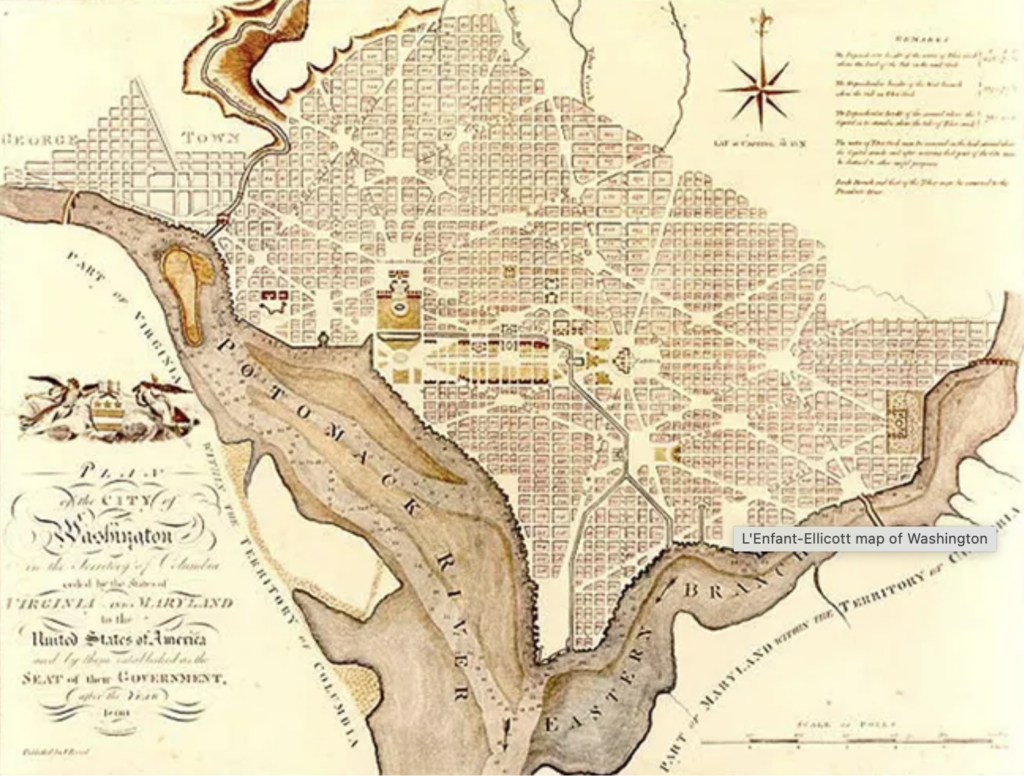
However, the phrase “Versailles of Democracy” stuck with me. The visionary Pierre L’Enfant’s city plan featured a series of diagonal avenues. The most important axis, Pennsylvania Avenue, provides a symbolic as well as direct link between the legislative and executive centers: the Capitol and the President’s House, https://www.nps.gov/articles/dc-monumental-core-the-lenfant-plan.htm. The plan also envisioned public lands that today are verdant parks and squares, and most importantly, the setting for monuments to important leaders and nation-changing historic events. This Cultural Landscape serves as a textbook that commemorates and reinforces our democratic ideals and values. Even if it is not officially inscribed as a World Heritage site, the principles it represents should be inscribed in our hearts and minds as a guide for our future.