
Do you have a memory of the railroad? Most of us do. Though decades have passed, I can vividly recall spending summers in southern West Virginia with my grandmother, watching coal trains pass by in the evenings as we drove into downtown Charleston along the Kanawha River. More recently, my family traveled on a heritage railway in Wales. Originally built to transport slate to quarries, the Ffestiniog Railway is now one of the country’s most popular tourist attractions.
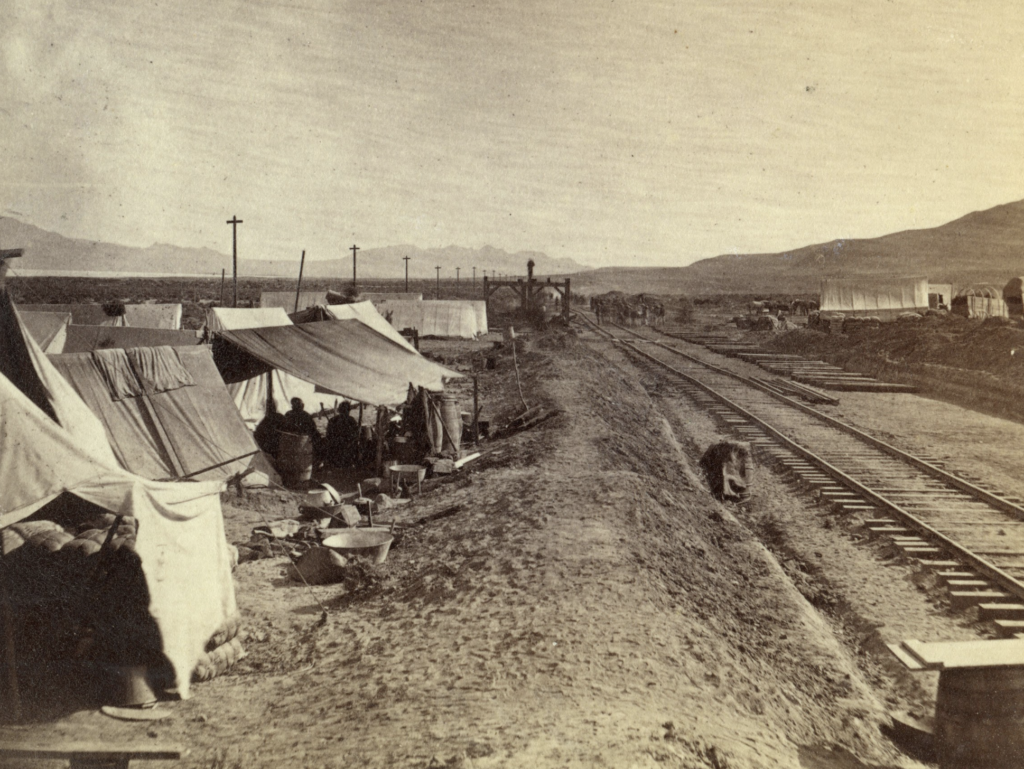
Railroads play an outsized role in American (and, indeed, global) history, memory, and culture, serving as both personal touchstones and as tangible symbols of economic, political, and military transformation. Perhaps no single road in the United States is as iconic as the first Transcontinental Railroad. Completed in 1869, it stretched roughly 2,000 miles from Council Bluffs, Iowa, to San Francisco, California, and was almost immediately lauded in the mainstream press as an engineering and technological marvel.
In the century that followed, this narrative remained largely dominant. Most accounts of the railroad’s construction were celebratory, erasing alternative, less triumphant perspectives, including those of diverse groups of Indigenous peoples and Chinese workers, whose labor largely built the western section of the line.
More recently, however, owing to the ongoing and tenacious efforts of activists, descendant community members, and scholars, this has changed – both in academic discourse and on the ground at public history sites. Even Congress has taken action to reassess the history of the Transcontinental Railroad, passing the John D. Dingell, Jr. Conservation, Management, and Recreation Act (Dingell Act) in 2019. Among other requirements, the bill directed the National Park Service (NPS) to reflect on its role in shaping the road’s memory and to expand the depth and breadth of information available at national parks.
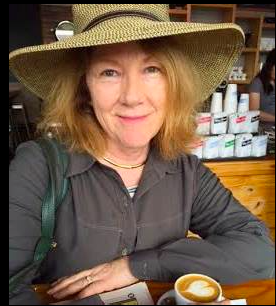
A key member of the team NPS assembled to address the Dingell Act was Dr. Laura Dominguez, a historian of California and the North American West. As a NPS Mellon Humanities Postdoctoral Fellow, Dr. Dominguez conducted research, facilitated public engagement, and drafted historical assessments, among other responsibilities. Late last year, I had the chance to interview Dr. Dominguez about her experiences for a special issue of the Parks Stewardship Forum (January 2026) focused on the Mellon Humanities Fellowship program. The full transcript is available here. Excerpts below highlight some of our conversation, especially as it relates to American history, mythic memory-making and -unmaking, and the NPS.
Eleanor Mahoney: For close to two years, you served as the NPS Mellon Humanities New Perspectives in Transcontinental Railroad History Fellow. That’s a long title—and a broad mission for a postdoctoral fellow! What first drew you to this position when you saw the job announcement posted?
Laura Dominguez: My academic training is in the history of the North American West and Ethnic Studies; I didn’t arrive at the NPS as an expert in railroad history. A couple of things really drew me to this topic and to this fellowship. I have a background in historic preservation, and a lot of my scholarship looks at the intersections of history and heritage conservation. In other words, I study how people make meaning out of the past and express their attachments to places. I am especially curious about how communities at the fringes of settler colonial societies in the American West have contested mythic narratives and patterns of erasure over time, as well as how they assert their own interpretations of history and preserve their own stories, places, and cultural practices. The fellowship invited me to better understand how the NPS was grappling with a topic that is so mythologized in US history and tied to the idea of national exceptionalism.
EM: Can you explain the idea of mythic memory-making a little more? Why is it so important to challenge or contest these mythic narratives? And how do you think this relates to the work of the National Park Service?
LD: A lot of my work is premised on the idea that history in and of itself is part of the infrastructure of settler colonialism in the United States. The stories that the US tells about itself—especially those that White settlers and their descendants tell about themselves—justify the taking of land, the attempted extermination and replacement of Indigenous Peoples, and the exclusion of many other people. It all depends on a particular rewriting and accounting of history. I’m particularly critical of the historic preservation movement and public history as helping to reinforce myths of American history about who owns and inherits the land, who has the rightful connection to the land, who is most productive on the land, and who has a right to belong in a particular place.
My scholarship focuses on Southern California, particularly because of the place it holds in the imagination of the US and beyond. For centuries, the region has represented a place of the future, a place that people can project their hopes and dreams onto. My own study of reparative memory-making and place-keeping in Los Angeles—the ways that racialized peoples conserved their heritage as a form of healing and as an expression of power and joy—is indebted to generations of scholars and community storytellers who have opened our eyes to the violence undergirding the fantasy of California’s past (including, but not limited to, the genocide and enslavement of Native Californians, the suppression and exclusion of immigrants, and many other forms of discrimination and erasure targeting Mexican, Black, and other communities). In one form or another, we can always find storytelling embedded in those practices of removal and displacement as justification.
Similar processes inform official or leading memories of the Transcontinental Railroad (and by that, I mean the stories enshrined in public lands, museums, historical societies, and popular culture). The nearly 2,000-mile-long road is a major physical expression of Manifest Destiny from the second half of the 19th century. It gives shape to the stories the US promoted after the Civil War: how the newly reunified North and South could find common hopes and dreams in the West, and how that land was going to help heal the nation. To this day, we celebrate the railroad as a technological feat and a symbol of the ingenuity of American capitalism and of financiers and engineers. It has become an emblem of the genius of the American experiment in a lot of ways.
EM: I’m struck at how national parks were playing a quite similar role as the railroad in national mythmaking in the years after the Civil War. Have you noticed that too?
LD: Absolutely. Both national parks and railroads were part of the larger, westward colonial project during and after the Civil War, and both relied on erasure to advance a national story. They were premised on the idea that Native Americans and other marginalized communities were invisible or expendable.
Like the railroad, parks were a way for the US to promote national unity and identity and to seize and reimagine Indigenous lands as “public lands.” Early park advocates claimed that those lands were pristine, untouched swaths of wilderness, which ignored the deep, ancestral, and (often) migratory relationships Indigenous Peoples held with them.
We can make similar observations of the first US Transcontinental Railroad. For generations, mainstream public discourse and scholarship minimized the fact that the Pacific Railway Act (1862), which enabled the construction of the road, extinguished the rights of Native Americans to their traditional homelands. That law, championed by President Abraham Lincoln, upended decades of treatymaking that affirmed Native sovereignty.
Public memory also erased the labor responsible for the railroad, especially the experiences of skilled immigrant workers. Tens of thousands of people—mostly men, but some women—reshaped the land and laid the track under very difficult circumstances. Although the two railroad companies employed many different groups of people (including Civil War veterans), Central Pacific recruited thousands of Chinese workers to construct the most difficult sections of the line through California. Untold numbers of them lost their lives or suffered serious injuries during their service. Within two decades, many of those same men and their kin were targeted for violence and exclusion from the US. They remained anonymous in most historical documentation and interpretation.
Both national parks and railroads have inspired a fair amount of awe over the last century and a half. But for far too long, those celebrations occurred at the expense of the people whose stories are at the heart of our most significant places.
Want to read more? The full transcript is available here.
————-
Thanks to Parks Stewardship Forum for their permission to share these excerpts. A citation for the interview is Mahoney, Eleanor, and Laura Dominguez. “New Perspectives in Transcontinental Railroad History.” In Parks Stewardship Forum, vol. 42, no. 1, pp. 61-69. George Wright Society, 2026.
Learn more about Dr. Dominguez’s work at NowAndHere.org, a new website that highlights the work of more than 30 Mellon Humanities Postdoctoral Fellows.